

Hi folks,
It’s been a minute. Not just with this substack, which I enjoy writing, but with a federal poll. Our last one was in January!
We’ve been tied up with our clients, who keep giving us increasingly interesting work, so we haven’t had the chance to look at the federal landscape. And we brought back our Economic Patriotism Index to see if Canadians are still putting their maple leaf where their wallet is.
Let’s get into it.
Keep Calm and Carney On: The Liberals Have a Big Lead
The federal topline numbers are as follows: Liberals 45% (+4% since our last poll in January), Conservatives 32% (-6%), NDP 11% (+3%), the Bloc Québécois at 8% (+1%), and the Greens at 3% (-1%).
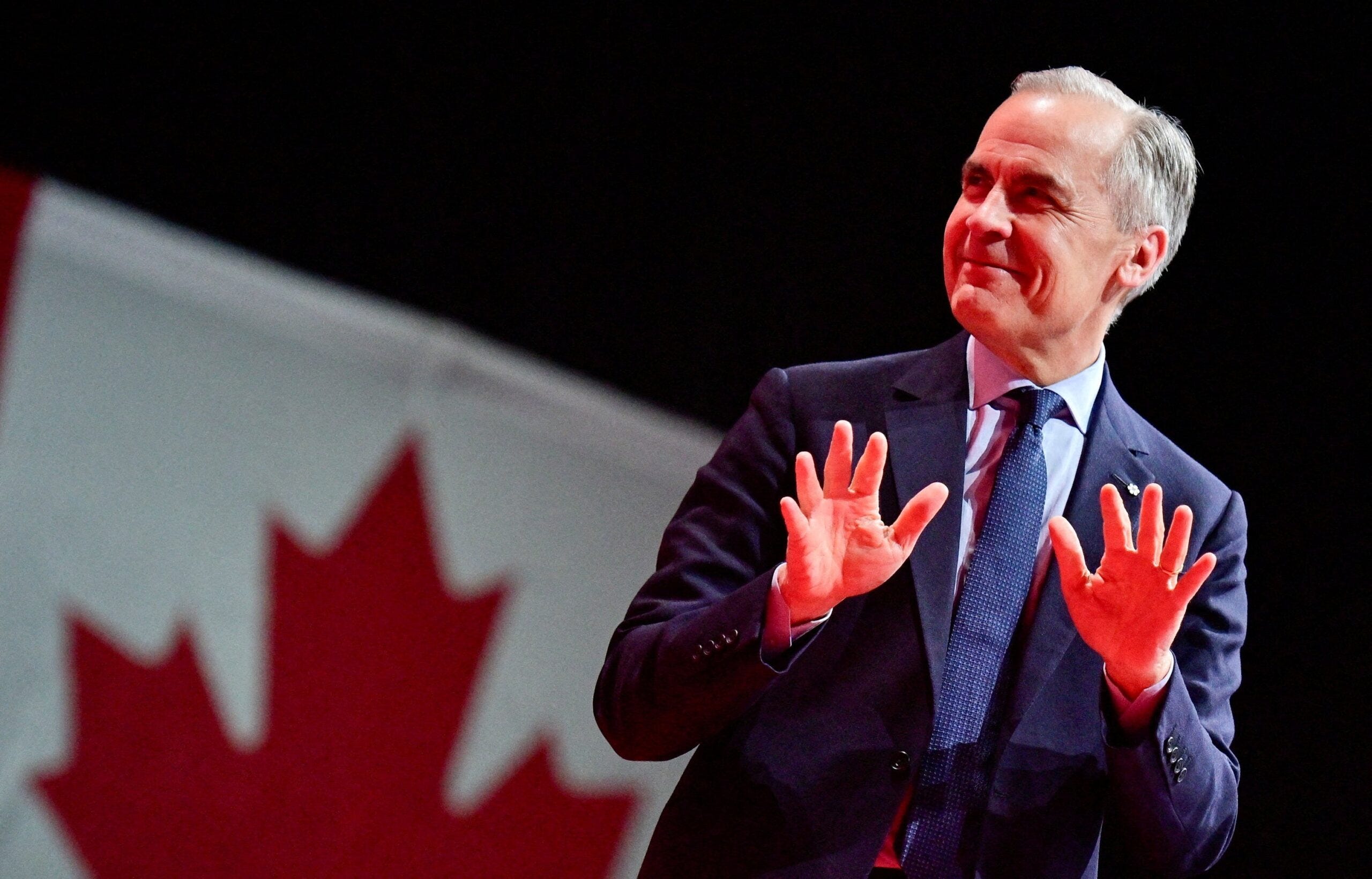
So what was a three-point Liberal lead in January is now a thirteen-point lead. And a lot has happened since our last poll. Conservative leader Pierre Poilievre won his leadership review with 87.4% of the vote, and Prime Minister Carney earned his majority government through a few defections from the opposition benches and by winning three by-elections last month.

Well, with these numbers, Carney can call an election today and can expect to win a larger majority.
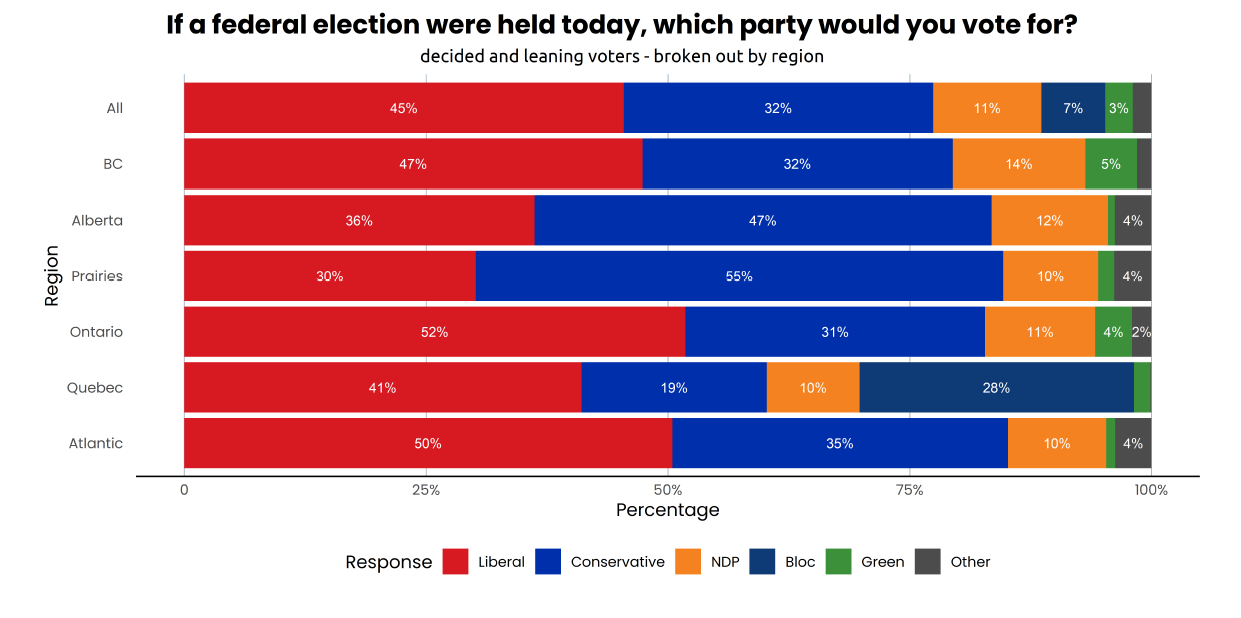
The Liberals find themselves in an unassailable position, with a 15-point lead over the Conservatives in the Atlantic region, a 13-point lead over the Bloc in Quebec, a 21% lead in Ontario, and a 15-point lead over the Conservatives in British Columbia.
But We Are Suddenly Less Economically Patriotic
We’ve been measuring economic patriotism since last May to test whether Canadians are willing to pay more to keep Canada economically independent.
High economic patriotism is down since December, from 34% to 26%. That’s an eight-point swing, and low economic patriotism is up four points from 24% to 29%.
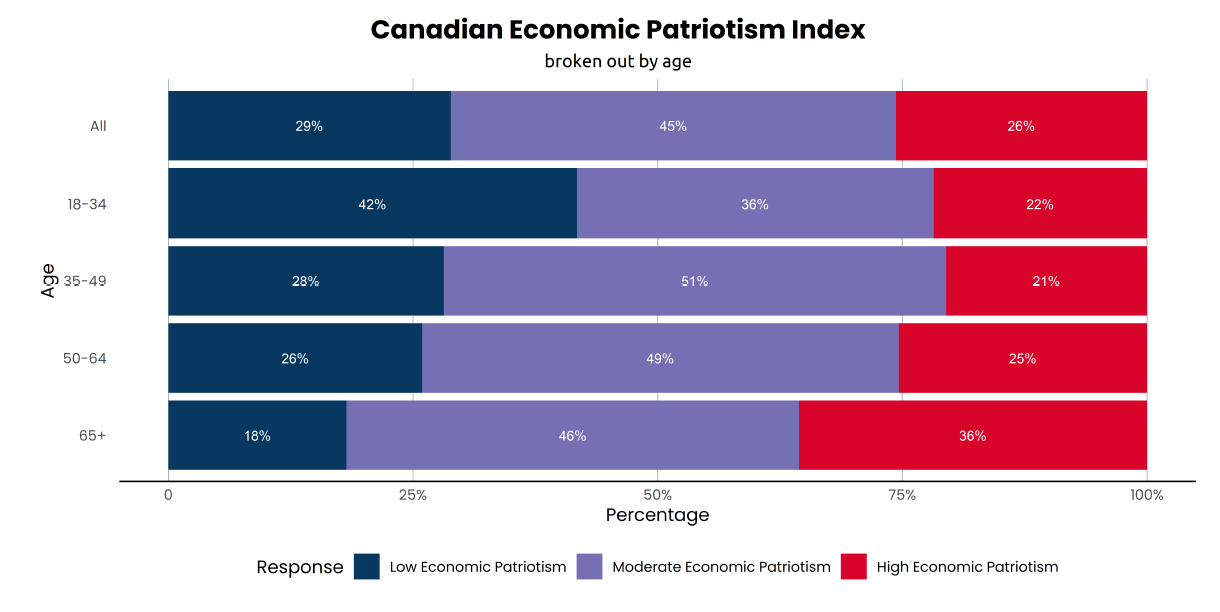
For the first time since we launched the EPI, more Canadians score low than high.
So what gives? Well, a few things, and they have to do with Donald Trump. Firstly, gas prices are skyrocketing thanks to the war in Iran that Trump started, and the desire for some relief at the pumps might be pushing down our willingness to buy Canadian, even if it means paying more.
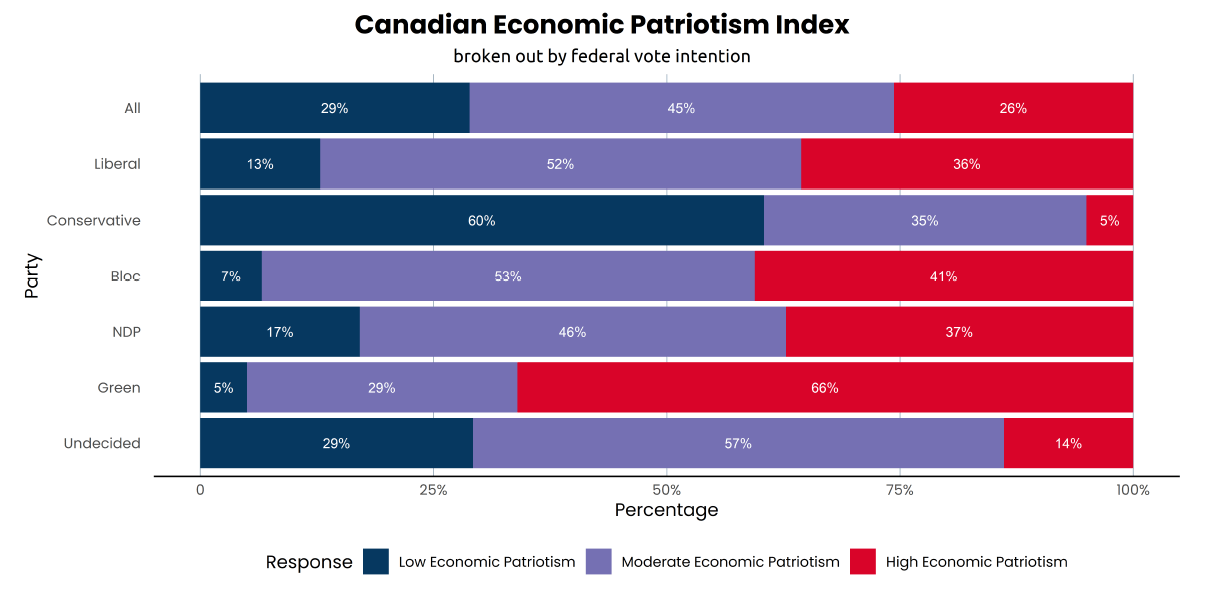
Second, Canadians might be becoming psychologically callous to all things Trump, especially when he is not talking about us. The trade war was supposed to radicalize Canadians into economic nationalists. Instead, as the immediate shock faded, the willingness to actually sacrifice softened.
Fewer liberal voters score high on the index (down 12 points from our January poll), and there has been a 9-point spike in low economic patriotism among Conservatives (51% in January to 60% now). And high economic patriotism has been cut in half among undecided voters (31% in January, now at 14%).
We’re starting to find our limits here with paying for more Canadian goods. I note here that the levels of economic patriotism stayed the same during the Christmas shopping season, but it took gas prices to make Canadians rethink their attitudes.

Which is understandable. Blink, and Christmas has come and gone. We’ve been paying a king’s ransom at the pumps for well over two months.
But We Are Still Buying Canadian
But here’s the twist: behaviour hasn’t followed attitudes down.
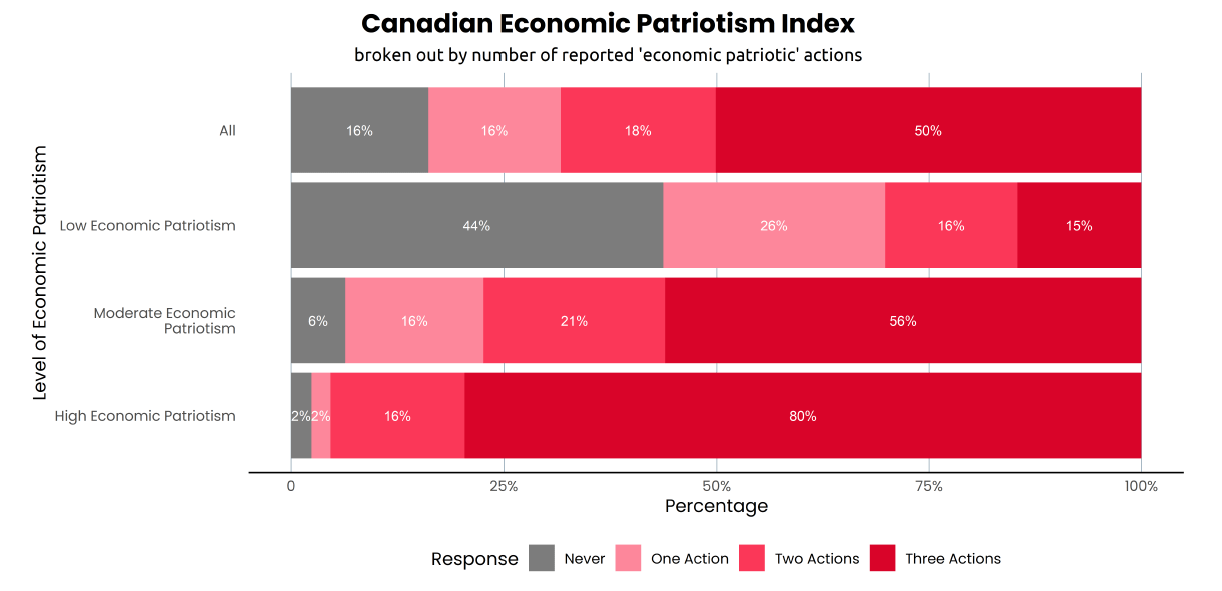
Half of Canadians are still doing all three Buy-Canadian actions. In December, 51% of all Canadians said they did all three economic patriotic purchasing habits1. Today, that number sits at 50%.
In survey research, we talk about the “say-do” gap.
This is when survey respondents say that they will do something on a survey, but their actual actions in the market (or voting behaviour) don’t reflect that.
A majority of respondents will say that they want to eat healthier food, go to the gym more often, or vote, but their real-world behaviour never aligns with those desires. As we all know, a majority of people don’t do those three things.
But here we have the reverse. Canadians are doing more than they’re saying. Their attitudinal commitment to economic patriotism is softening (high economic patriotism is down by 8 points since December), but their actual purchasing behaviour hasn’t followed suit.
Canadians are acting more patriotically than they are ideologically committing to it.
Our values are softening faster than our habits. Actions are stickier than ideology.
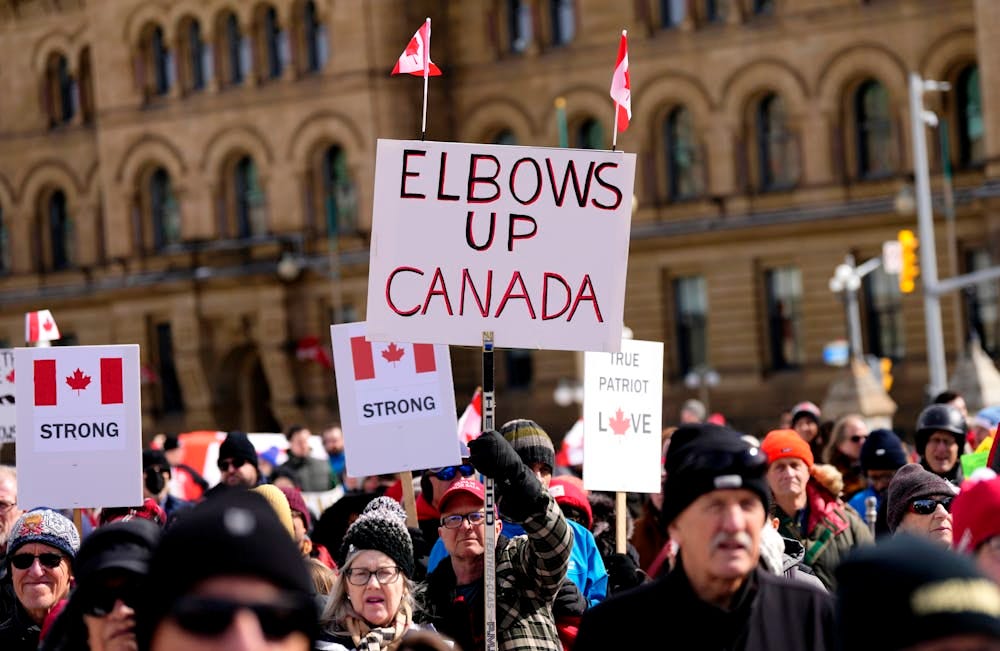
Economic patriotism might not be the giant middle finger to Trump it was last year. It is now behavioural and pragmatic. It is a sober show of solidarity with our neighbours and their businesses, not against Trump.
The behaviour is ahead of the attitude because behaviour doesn’t require a settled worldview. You check the label, you choose the Canadian product, you change where you shop. Those are small frictions, not commitments.
The attitude is softening because the ideological question of our relationship with the United States remains unresolved, and Canadians don’t quite know what to think yet.
At Davos, Mark Carney told the world that the old order is broken and won’t come back (“Nostalgia isn’t a strategy”). Pierre Poilievre told Joe Rogan that the US-Canada friendship is worth saving and the current friction is an aberration.


They both can’t be right.
So Canadians are doing the patriotic thing (buying Canadian, checking labels) while waiting to see who’s right about the bigger question.
This doesn’t mean that Canadians are economically nationalist. They won’t necessarily sign up for a permanently more expensive, more restructured economy, simply because they haven’t decided whether that restructuring is necessary or whether normal is still coming back.
The EPI is doing exactly what a good instrument should do. It’s detecting that distinction in real time. It’s showing you a public that is patriotically engaged but ideologically unresolved.
And the reason it matters is that resolving that tension is the central political question of the Carney mandate.
When Canadians finally decide whether Carney or Poilievre is right about the permanence of this rupture, the EPI will show it first.
Thanks for reading!
Joseph
The three activities are;
1) Actively looking for “Made in Canada” labels when shopping;
2) changing purchasing behaviour due to trade disputes or political tensions;
3) personally choosing a more expensive Canadian product over a cheaper foreign alternative.